
Just how important are your feet?
By Dr. Annika
Did you know that when we walk, 3 times our bodyweight goes through our big toe joint?
Our feet are an incredible piece of anatomy, with intricate spring loading and 4 curve arrangements to allow you to glide along on Earth.
But what happens if things aren’t quite right?
Most people understand that if your feet don’t work, such as if they are flat, the twist gets transferred up to the knees, and then to the hips and up into the back. It is obvious that this then leads to the muscles not working in their best positions and capacity.
But there is much more to that than meets the eye.
What are some of the possible symptoms of foot problems?
- Foot, knee, hip and back pain
- Feeling tired in the afternoon after you have been on your feet all day.
- Your head feels heavy and leans forward (you often don’t notice until it’s been addressed)
- Scoliosis
- You walk heavily
- Your feet turn out
- You have calluses on your feet
- Your big toe knuckle
- Your feet look flat on the instep or outside, or under the ball of your foot
- Your toe tips rather than the undersurface touch the ground when you stand and your toes look more like claws than toes.
- Poor balance
How do you know if you have a foot problem?
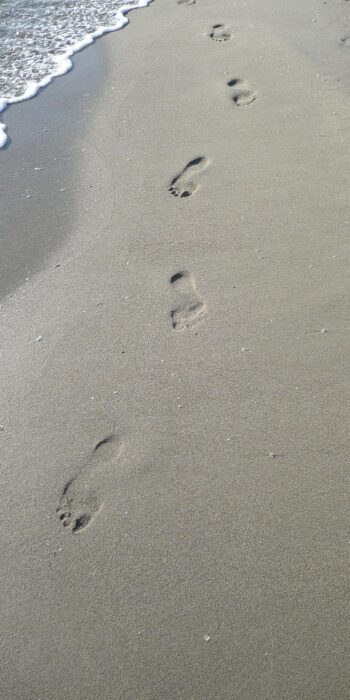
A quick check is to have a look at your footprints in the sand. Both of your feet should be pointing forward, and the biggest grooves should be under your heel and the big toe. The outside part of the print should be quite narrow. Have a look at the picture above to see what a non-ideal print looks like
How do you end up with foot problems?
Feet are designed to be bare and on uneven ground, feeling things like grass and stones and boulders and tree bark and mud, and adapting to the ground. In our civilization, you are on flat surfaces almost always. This leaves the feet without much stimulation, which is what the brain needs to engage our core and use our muscles, joints and bones optimally.
To add insult to injury, you wear shoes, which often restrict the foot from moving properly (don’t get me started on high heels!) and, especially if very cushioned, essentially leads to sensory deprivation. The brain can’t really read what’s going on in the field of gravity and has to guess, based on information coming from your balance organs in our ears, your sight and joint position sense.
This is why you’re often are tired in the afternoon – the brain uses up a whole lot of energy just keeping you upright, let alone trying to do everything else you do.
The reason why you might have calluses is because the muscles in the feet wither, not holding the arches up properly, which means that the wrong parts of the foot are being used for weightbearing. The skin under the heels and big toes, that is designed to weight-bear, is reinforced.
In 30 years of practice, I have felt ONE person’s feet that felt like they were strong and functional – they felt a bit like hands. Everyone elses’, surprisingly including dancers’, feel rigid in comparison.
What can we do to improve this situation?
Walk with your bare feet touching the ground as much as you safely can. Trampolining and stand-up paddle boarding are also good. The problem is, though, that these activities don’t make up for the vast majority of the rest of the time when you’re on flat surfaces (in bare feet or otherwise).
We recommend better balance orthotics, which are a slimline orthotic that fit in any shoes, even sandal. They have soft cushions that stimulate the brain so it knows what’s going on. There’s no support, it’s like gym for feet, essentially.
We have worked with these orthotics for over 20 years, and the feedback we’ve had is so positive! For example, feeling less tired in the afternoon. Much better balance and fewer injuries. This is not just super relevant to older people! One comical incident was some young netball ladies who missed their hoops for a couple of weeks after fitting their orthotics, because their body was working so differently.
And yes, we use them ourselves.
if you are thinking that this sounds like something that would benefit you, let us know next time you’re in for a visit!
Here’s the link if you’d like to check out the website https://betterbalanceorthotics.com/